
Liability for Commercial Truck Underride Accidents
Liability in commercial underride accidents typically turns on whether the trucking company, driver, or equipment manufacturer failed to install or maintain required underride safety protections.
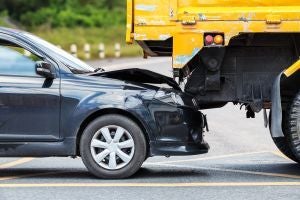
Commercial truck underride accidents occur when a passenger vehicle slides beneath a tractor-trailer.
These truck collisions are among the most severe roadway events and frequently result in fatal or incredibly severe, life-changing injuries.
Underride cases are highly technical, involving federal trucking regulations, engineering standards, and detailed crash reconstruction.
In California, these claims often involve multiple layers of responsibility that extend beyond the driver alone.
Injury Justice Law Firm can help you. To schedule a consultation, call (818) 394-7835 or contact us here.
What Is a Commercial Truck Underride Accident?
An underride accident happens when the front of a smaller vehicle becomes trapped under the side or rear of a commercial trailer.
Because the trailer's floor is significantly higher than passenger-vehicle bumpers, the occupant compartment can be crushed or sheared off. There are generally two types of underride collisions:
- Rear underride accidents occur when a vehicle strikes the back of a trailer
- Side underride accidents occur when a vehicle slides beneath the side of a trailer during turning or lane changes
Why Do Underride Accidents Happen?
Underride collisions are rarely simple traffic incidents like you see in left-turn or rear-end accidents. They are often the result of overlapping failures involving equipment, training, and compliance. Common contributing factors include:
- Missing or defective underride guards
- Poor trailer visibility or broken lighting systems
- Improperly stopped or unmarked trailers on highways or shoulders
- Sudden lane changes by commercial trucks without adequate clearance
- Inadequate reflective tape or markings are required under federal safety rules
- Noncompliance with Federal Motor Carrier Safety Administration standards
Each of these issues may shift liability from a single driver to a broader trucking operation or a third party responsible for maintenance or design.
Federal Safety Rules Governing Underride Protection
Underride protection is regulated at the federal level under the Federal Motor Vehicle Safety Standards. Rear impact guards are addressed in 49 CFR § 571.223, which sets performance requirements for energy absorption and structural strength.
Further, installation standards for rear guards are set forth in 49 CFR § 571.224, which specifies mounting heights and crash resistance thresholds.
Additional commercial carrier safety obligations are governed by the Federal Motor Carrier Safety Regulations under 49 CFR Part 393, which include lighting, marking, and equipment maintenance requirements.
These regulations can be difficult for the average person to understand, but the takeaway is: when these standards are ignored or poorly implemented, the risk of catastrophic underride outcomes increases significantly.
Who Can Be Held Liable in an Underride Accident?
Liability in underride cases is rarely limited to the truck driver. These claims often involve a layered investigation into multiple entities. Potentially responsible parties include:
- Trucking companies that fail to enforce safety protocols or inspection routines
- Truck drivers who operate vehicles unsafely or violate traffic laws
- Maintenance contractors are responsible for inspecting trailers and safety guards
- Manufacturers of defective underride guard systems or trailer components
- Cargo loading companies that create unsafe weight distribution, affecting braking or stability
In California litigation, each entity is evaluated for its role in creating or failing to correct a hazardous condition. Liability can be apportioned across several parties depending on the evidence.
Commercial Truck Underride Accidents: Potentially Liable Parties
| Party | Potential Basis for Liability |
|---|---|
|
Truck Driver |
Unsafe lane changes, improper stopping, distracted driving, and traffic violations |
|
Trucking Company |
Failure to maintain vehicles, negligent hiring, inadequate training, and FMCSA violations |
|
Maintenance Contractor |
Failure to inspect, repair, or replace defective underride guards or safety equipment |
|
Trailer Owner |
Allowing unsafe trailers to remain in service with defective guards or lighting systems |
|
Equipment Manufacturer |
Defective underride guard design, manufacturing defects, inadequate crash protection |
|
Cargo Loading Company |
Improper loading affecting braking, stability, visibility, or vehicle control |
Example 1: Defective Rear Underride Guard
A passenger vehicle collides with the rear of a stopped tractor-trailer. Investigation reveals the rear underride guard was rusted and failed during impact. Liability may extend to the trucking company, maintenance provider, and trailer owner.
Example 2: Poor Trailer Visibility at Night
A driver crashes into the side of a trailer crossing a highway intersection because reflective tape and lighting were missing. The trucking company and trailer owner may be responsible for failing to comply with federal visibility requirements.
Example 3: Defective Underride Protection System
Crash reconstruction shows that the underride guard collapsed despite a relatively moderate impact. Engineering analysis identifies a manufacturing defect, potentially creating liability for the trailer or equipment manufacturer.
How are Underride Accidents Investigated?
Underride claims require immediate and detailed evidence preservation. Critical evidence can disappear quickly after a crash, especially when commercial carriers control the vehicles involved.
Unrelated to the accident, companies often feel the pressure to get their drivers and vehicles back in operation for financial reasons.
Key evidence our team will collect often includes:
- Electronic logging device data showing speed and driving time
- Event data recorder information from the truck and the passenger vehicle
- Inspection and maintenance records for underride guards
- Dash camera or surveillance footage from highways or nearby businesses
- Driver qualification files and training records
- Highway debris and crash scene measurements used in reconstruction analysis
In many cases, accident reconstruction experts are used to determine vehicle positioning, impact angles, and guard failure points.
Why Do These Cases Often Involve Catastrophic Injury?
Underride accidents frequently result in traumatic outcomes because the passenger compartment is exposed to direct structural intrusion.
Direct structural intrusion is a simple means of what happens when a truck's heavy frame or cabin crushes directly into the smaller vehicle's passenger space during a crash, physically trapping or injuring the people inside.
Common injuries include:
- Traumatic brain injuries
- Spinal cord injuries and paralysis
- Crush injuries to the torso and lower extremities
- Severe internal organ damage
- Wrongful death due to the catastrophic impact of forces
What are Civil Claims and Legal Theories in Underride Accident Cases?
Underride litigation often involves multiple overlapping legal theories rather than a single claim. Common causes of action include:
- Negligence in vehicle operation or fleet management
- Negligent maintenance of safety equipment
- Product liability for defective underride guard design or manufacturing
- Violation of federal safety regulations used as evidence of negligence
- Negligent hiring or supervision of commercial drivers
Each theory may support a different category of damages depending on how the crash occurred.
Because there can be so many parties involved and many contributing factors to the crash, it's important to work with a legal team that understands the intricacies and time commitment of a commercial truck accident investigation.
Related Laws in Commercial Truck Underride Accident Cases
Federal Motor Vehicle Safety Standard 223 – 49 C.F.R. § 571.223
FMVSS 223 establishes federal performance requirements for rear underride guards on commercial trailers, including strength, energy absorption, and crashworthiness standards.
Federal Motor Vehicle Safety Standard 224 – 49 C.F.R. § 571.224
FMVSS 224 governs the installation requirements for rear impact guards, including guard placement, mounting specifications, and dimensional requirements designed to reduce underride collisions.
Commercial Motor Vehicle Equipment Standards – 49 C.F.R. Part 393
Federal regulations require commercial trucks and trailers to maintain proper lighting, reflective tape, brakes, tires, and safety equipment. Violations may be used as evidence of negligence in underride accident litigation.
Inspection, Repair, and Maintenance Requirements – 49 C.F.R. § 396
Federal law under 49 C.F.R. § 396 requires trucking companies to systematically inspect, repair, and maintain commercial vehicles and safety equipment, including underride protection systems and trailer components.
California Negligence Law – California Civil Code § 1714
California Civil Code § 1714 establishes the general duty of care requiring individuals and companies, including trucking carriers, to act reasonably and avoid conduct that creates an unreasonable risk of harm to others. This statute often serves as the foundation for personal injury and wrongful death claims arising from commercial truck accidents.
Frequently Asked Questions (FAQs)
What is a commercial truck underride accident?
A truck underride accident occurs when a passenger vehicle slides underneath the rear or side of a commercial truck trailer. These collisions often result in catastrophic injuries or fatalities because the trailer can intrude into the passenger compartment.
Who can be held liable for a truck underride accident?
Liability may extend to multiple parties, including the truck driver, the trucking company, the maintenance contractor, the trailer owner, the cargo company, or the manufacturer of a defective underride guard system.
What is an underride guard?
An underride guard is a safety device installed on the rear of a commercial trailer, designed to prevent smaller vehicles from sliding under the trailer during a collision. Federal regulations establish specific performance and installation requirements for these guards.
Are trucking companies required to inspect underride guards?
Yes. Federal Motor Carrier Safety Administration (FMCSA) regulations require commercial carriers to inspect, maintain, and repair safety equipment, including underride protection systems, lighting, and reflective markings.
What damages can be recovered in a truck underride accident lawsuit?
Victims may seek compensation for medical expenses, lost income, future medical care, pain and suffering, rehabilitation costs, disability-related losses, property damage, and wrongful death damages when a fatality occurs.
Why is it important to hire a lawyer quickly after an underride accident?
Critical evidence, such as electronic logging device data, maintenance records, dashcam footage, inspection reports, and vehicle components, may be lost or destroyed if not preserved quickly. Early legal representation helps protect evidence and identify all potentially liable parties.
How is Liability Proven in Underride Cases?
Establishing liability requires connecting regulatory violations, mechanical failure, and crash dynamics. Proving liability in these cases often involves:
- Demonstrating failure to comply with FMCSA inspection requirements
- Showing underride guards were missing, improperly installed, or defective
- Using engineering analysis to prove structural failure at impact
- Linking driver conduct to unsafe stopping or turning behavior
- Establishing notice of prior violations or maintenance issues
Hypothetical Case Study: Rear Underride Collision on Interstate 5
A passenger vehicle traveling on Interstate 5 in Southern California approaches slowed traffic near a construction zone.
A commercial trailer, stopped abruptly in the right lane without adequate hazard marking, becomes a stationary obstruction. The passenger vehicle collides with the rear of the trailer and slides underneath it.
The occupants suffer catastrophic injuries, including severe spinal cord trauma and blunt force head injuries. The trucking company initially claims the driver was operating safely and that the passenger vehicle was speeding.
A detailed investigation reveals several critical failures. The trailer's rear underride guard was corroded and failed on impact, collapsing under minimal force.
Maintenance logs show missed inspections over several months. The vehicle also lacked the proper reflective tape required under federal standards.
Our team at Injury Justice Law Firm focused on reconstructing the collision using event data recorder downloads, physical crush analysis, and inspection of FMCSA compliance records.
The evidence demonstrated that the trucking company allowed a known defective guard system to remain in service despite prior safety citations.
Liability was established through a combination of regulatory violations and mechanical failure analysis. The case also highlighted how improper maintenance practices can transform a survivable crash into a fatal underride event.
Why Do These Cases Require Technical Legal Analysis?
Surface-level accident reports do not resolve underride litigation. It requires a detailed review of federal compliance standards, engineering performance, and carrier safety history. Key challenges include:
- Disputes over whether underride guards met minimum federal specifications
- Conflicting accident reconstruction findings
- Corporate defense arguments attributing causation to passenger vehicle speed
- Spoliation risks when trucking companies delay evidence production
These cases often hinge on technical evidence rather than heavily on eyewitness accounts.
What is the Role of Truck Manufacturers and Equipment Designers in Underride Accidents?
In some cases, liability extends beyond the carrier to the manufacturer of the underride guard system or trailer itself.
Defective design claims may arise when guards fail to absorb energy as required under federal testing standards. Manufacturers may be evaluated for:
- Structural design flaws
- Use of substandard materials
- Failure to warn carriers of known limitations
- Inadequate crash testing or certification procedures
- These claims are often supported by engineering experts who analyze deformation patterns and material failure points.
How Does Legal Strategy Develop in Underride Litigation?
Underride cases require coordination across multiple disciplines, including accident reconstruction, mechanical engineering, and regulatory compliance analysis. Liability is often built incrementally through layered evidence rather than a single decisive fact.
In many matters handled by Injury Justice Law Firm, litigation strategy focuses on integrating federal safety violations with physical crash evidence to establish a clear chain of responsibility across all contributing parties.
Our Los Angeles-based attorneys are here to help you. Schedule your consultation today.